A review of 2025
Head of Bectu Philippa Childs looks back on 2025.
Five years on from the upheaval of the pandemic, many freelance workers across our industries are still fighting to regain stability. By the end of 2020, thousands who had been excluded from government support schemes were pushed to the brink, and for many in theatre and live events, the prospect of returning to work felt impossibly distant. We have certainly moved forward since then, but too many of our members remain on unsteady ground.
That’s why we pressed so hard for the creation of a Freelance Champion – someone inside government who understands the realities of freelance working life to ensure that freelancers are properly considered in future policy. Mid-year, we were pleased to receive confirmation from the Department for Culture, Media and Sport that the role will finally be established, and we have urged the government to make the appointment swiftly in the new year. It is a significant step, and we will continue pushing to ensure freelance workers are front and centre in every legislative and policy decision that affects our industries.
Bectu’s Big Survey
This year we conducted Bectu’s Big Survey, the largest-ever survey of behind-the-scenes creative workers, with over 5,500 responses from across the sector.
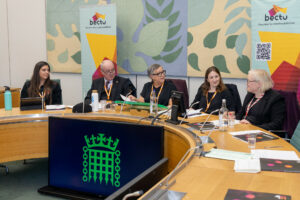
Bectu’s Big Survey roundtable
The survey highlights that the creative industries are rife with job insecurity, precarity, long hours and lack of protections for freelancers.
We took the findings to parliament for an important roundtable, and we will continue to use the wealth of data to work with members, industry bodies and policymakers to secure meaningful improvements to pay, rights, diversity, and working conditions.
Tackling long hours and setting fairer industry standards
Long working hours remain one of the most serious issues facing our members. Too many freelancers in film and TV routinely experience “broken turnaround” – finishing late, starting early, and working with less than 11 hours’ rest. This is unlawful and unsafe, and this year Bectu escalated the issue with the national regulator for workplace health and safety, the Health & Safety Executive. Our talks with Pact have widened to include more employers in the hope of securing sector-wide solutions. It will not go away until it is genuinely resolved.
We also continued negotiations with Pact on two important new agreements: one for unscripted productions, and another for freelancers working on films with budgets under £30 million. These agreements will be crucial for improving working lives and setting clearer, fairer industry standards.
Broadcasting sector faces further changes
Across the broadcasting landscape, change has been constant. While the Labour government has adopted a more constructive stance toward the BBC, the corporation continues to operate under intense political and financial pressure. Bectu has consistently defended the BBC’s independence, calling for an end to political appointments to its Board and for reform of the 10-year Royal Charter cycle. With the launch of the Charter Renewal this week, our members’ needs will be central to our response to the public consultation.
Meanwhile, challenges at ITV and ITN have included redundancy consultations and wider market uncertainty – with ITV now in talks to sell its television business to Sky.
Modernising working conditions in arts and entertainment
In theatre, Brexit has posed major obstacles for touring productions. We welcomed the government’s recent commitment to address this but will continue pushing for firm progress towards an agreement on touring visas and an end to the uncertainty. Our agreement with UK Theatre has also become outdated, and the need for modernisation is clear. Throughout the year we held joint workshops with UK Theatre members, and formal negotiations are now set to begin on a revamped main agreement and a more suitable touring agreement. Our agreement with UK Theatre has also become outdated, and the need for modernisation is clear. Throughout the year we held joint workshops with UK Theatre members, and formal negotiations are now set to begin on a revamped main agreement and a more suitable touring agreement.
Our live events branches also had a strong year. The Better Festivals campaign saw around 50 reps out across the summer, gathering experiences from workers and highlighting the need for safer, more sustainable working environments.
A more equal sector for all
Equalities work has remained central. The Hair, Makeup and Prosthetics branch and our Black Members’ Committee have been at the forefront of efforts to end discriminatory practices affecting ethnic minority performers. It is unacceptable that qualifications still allow textured-hair training to be optional, and we are working with major hair and beauty organisations to finally correct this.
We have continued to support the establishment of the Creative Industries Independent Standards Authority (CIISA) and have urged broadcasters, production companies and other employers to sign up and contribute to its long-term funding. High-profile cases this year have once again confirmed that tackling and rooting out sexual harassment and unsafe workplaces requires a united industry commitment.
International solidarity has been an important thread throughout the year. We joined with sister unions and the TUC in condemning the killings of Palestinian media workers and the ongoing war in Gaza. Following devastating wildfires on the west coast of the US, our branches organised collections of equipment to support fellow media workers who had lost their homes and livelihoods.
Looking ahead, there is reason for cautious optimism. New industrial legislation, the Employment Rights Bill, will strengthen basic rights: protection from unfair dismissal will come after six months instead of two years, and sick pay and paternity rights will begin from day one. New laws will also make it easier for unions to organise, which we know leads to better outcomes for workers.
I hope that by this time next year we will be able to look back on real, measurable improvements. For now, I wish all our members a happy Christmas and new year, and my thanks for everything you do to support these industries we care so deeply about.