Prospect reps quiz Business Secretary Peter Kyle MP at National Conference 2026
Peter Kyle MP, the Secretary of State for Business and Trade, was the guest speaker at Prospect National Conference this year, where reps had the opportunity to ask him questions on a variety of pressing workplace and social issues.
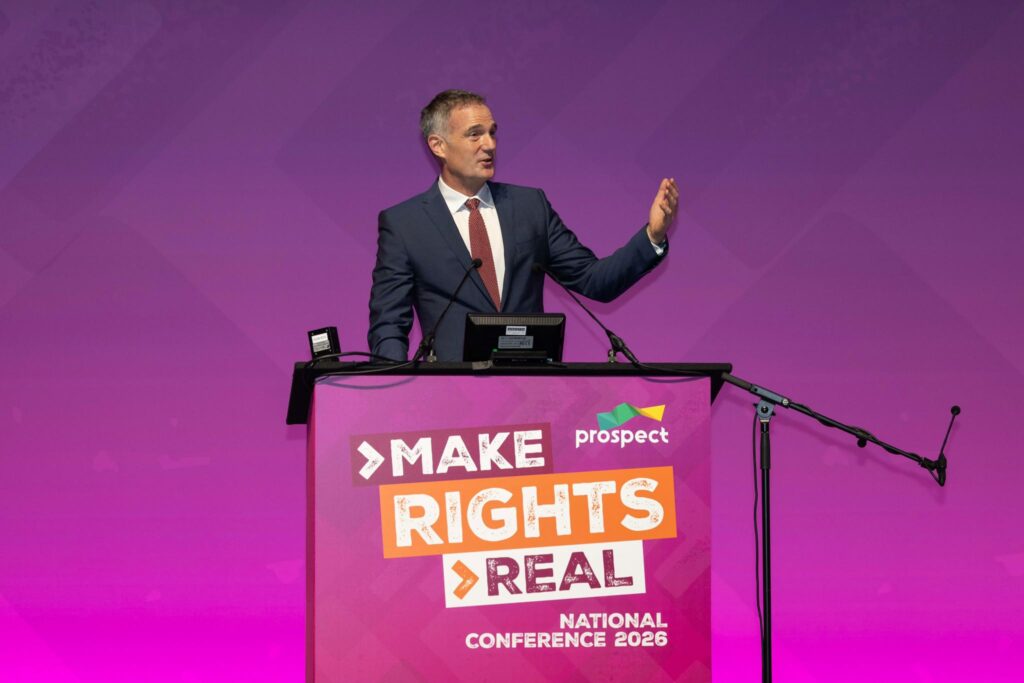
Business Secretary Peter Kyle MP at Prospect National Conference 2026
In his opening remarks, Mr Kyle, who is also the local MP for neighbouring Hove and Portslade, said:
“One of the first things that we did was overturn so much of the anti-union legislation that had been passed in the previous 14 years of Tory government.
“We set right about modernising the relationship between workers and the workplace, addressing the workers’ rights that had been denied and the progress that had been delivered in previous generations.”
On the Employment Rights Act, he said:
“I believe this is the largest shift in rights for people in the workplace for well over a generation. It didn’t happen by accident. It happened because we have a Labour government listening to, working with, and partnering with trade unions—channeling the voice, the insight, and the wisdom that you have.”
However, the Business Secretary, set aside a large proportion of his allocated time to answer questions from conference delegates.
In this transcript, his answers have been edited for length and clarity.
How far is the industrial strategy, with its emphasis on growth, resulting in the reduction of protection of workers’ rights and the well-being of the public in areas such as health and safety? Angela Mason (Writers, Producers and Directors)
PK: We will not allow the degradation of rights in the workplace. This is a government which is investing in workplace rights. Just since April, we have established the Fair Work Agency, bringing together three agencies and giving it additional powers to investigate and to sanction.
Not only are we extending rights across the workforce and bringing in new rights for the moment that we’re living in — bearing in mind so many people are now moving towards an app-based relationship with their employer — but we are also giving more powers to launch inquiries, conduct investigations, and bring sanctions.
What we do need to do is to make sure that health and safety regulations are fit for the moment we are living in, because the public interacts with the world around them in a very different way than they did before.
This is not about the degradation of regulations, nor is it about ever taking away the protections and rights that people have. But the world is changing incredibly fast. We need to make sure that the legislation, the regulation, and the way we keep people safe in the 2020s is fit for the 2020s going into the 2030s.
What thought is being given to future-proofing the Employment Rights Act, so that any future government that might come in, which may not be quite so sympathetic to people’s rights at work, can’t just undo it? Keith Flett (BT Corporate)
PK: This is the question that gives me the most anxiety about this agenda. Any other party that has the potential to win — the Tories or Reform — have both pledged to overturn every single piece of workers’ rights legislation that we’ve introduced.
When you look at the policies that the Labour Party of the past brought in, such as the welfare state, they have been attacked by other parties but they haven’t been overturned. Why? Because the public accepts them, celebrates them, and wants them to remain.
We must make sure that we celebrate these new rights that we have.
Sometimes I am frustrated when I turn the TV on and I hear people saying, “It’s not enough, it’s not good enough, and we haven’t done enough on rights.”
What that does is undermine the confidence of the public who aren’t directly affected by this, but who do vote on the back of what they hear from unions, from businesses, and from people who are out there independently giving their views on the government.
If we don’t stand together and celebrate progress—even though it’s not always perfect—I fear we could get to an age where Reform comes in and overturns all of it.
As a member of a regional branch with 1,200 members and many different employers—some with only one or two employees—what is the government’s plan to educate employers on the Employment Rights Act and advise how they should interact with the unions? Jeffrey Rowlinson (Scotland Regional)
PK: This is exactly the reason why we have staged the implementation of the Act. Of course, it is a very meaty piece of legislation that we need to take stage by stage. One of the reasons we sequenced it in this way is to allow employers to understand each step forward, but also to give time for us as a department to communicate, via unions and employer organisations, ensuring all information is available to them at each step of the way.
If we had done it in one big bang, I fear there would have been pockets of ignorance out there and workers wouldn’t have had all of the rights they need.
I accept that there is a particular challenge in getting right the way down into the economy when it comes to making people aware of workplace rights. Crucially, we also need to ensure that employees and workers are fully aware of these rights so that they can assert them.
In regulated industries, what guidance has the government provided to regulators to ensure that measures aimed at improving efficiency, or reducing costs, do not result in undue pressure to weaken established employee terms and conditions, where these have been agreed through existing employment and industrial relations frameworks? Aaron Curtis (Air Traffic Control Officers)
PK: While I am not an expert on the specific regulatory framework that applies to the CAA, in general, each regulator is slightly different and interacts with its sector in unique ways.
I know there is an issue directly related to the CAA at the moment that you are dealing with, and I know you have met with transport ministers recently to discuss it, which I think is exactly the right way forward.
It is really important that we, as a government, recognise that just because regulators are independent, it doesn’t mean they don’t have a responsibility to be cognizant of the government’s priorities.
You can see that this government has a clear priority for economic growth. However, we also have a clear priority regarding the importance we’ve attached to the workers’ rights legislation and our focus on modern industrial relations. This is a top priority for the government, and I know each department is making its respective regulators aware of that.
The government sets the rates for the skilled workers visa thresholds, as well as public sector pay. How can we reach a point where either public sector pay is high enough, or skilled worker visa thresholds are low enough, that we can have STEM experts working in the public sector and staying here? Right now, we have valuable skills that we can’t retain because the threshold is too high. Deborah O’Sullivan (Met Office)
PK: The Home Office is currently undertaking reviews into this, and it is a really important area. One of the things we had to do to get into office, and to earn the trust of people right around the country who had concerns about immigration numbers, was to get a grip on the overall system. Since Boris Johnson’s peak, overall net migration to the country has been reduced by two-thirds.
By doing so, we ensure that when people do come into the country, they are treated with dignity and respect because they are here legally, and they should enjoy all of the benefits of life in modern Britain—without question, both in the workplace and in society in general.
I accept that there is an ongoing conversation regarding your point; we are very aware of it, and these are conversations which myself and others are having with the Home Secretary quite regularly.
What steps is your department taking to incentivise employer investment in workforce upskilling and training to ensure regional businesses have the talent needed to drive long-term economic growth and achieve net zero? Rebecca Downing (National Grid Electricity Distribution)
PK: You very cunningly put about five questions into one sentence there, which I completely admire you for!
Net zero remains a priority for this government. Let’s be really clear: we are determined to get our country back on track when it comes to those key targets, whether it’s the transition of our vehicles by 2035, or achieving net zero by 2050.
We have to be pragmatic about how we reach those targets, which were set some time ago, especially as consumer demand and economic circumstances have changed along the way.
What we need to do is make sure we take the whole country and every community with us. Crucially, that means that where there is an industrial transition to equip the country for the next generation of energy supply, we don’t leave any communities behind.
The opportunities are profound, but only if you have a government that makes decisions based on the choice to take communities, places, and people from all parts of our society and age groups with us. And we will.
In UKRI, our representatives are preparing to negotiate a program of cuts that is likely to cost us long-serving experts, unique scientific facilities, and a lot of morale. So my question is: where is our growth in research funding to match the UK’s growing ambitions? Tristan Canfer, Uk Research and Innovation
PK: When we came into office and talked about the fiscal black hole and the chaos that we inherited, those first few days left a mark on me. When you get those stark briefings on the state of the finances, policy, and morale within your department, I was absolutely slack-jawed and deeply worried.
But in the midst of all of it, I was there lobbying and screaming about the virtues and the importance of R&D. I don’t know any struggling organisation that turns itself around without innovating its way forward, and the same applies to our country.
Very few parts of government have seen the same level of investment growth as overall R&D. That funding is what enabled me to invest in the gigafactory in the South West, to partner with the pharmaceutical and life sciences sector to increase innovation, and to get more resource into our universities — even though I accept they are still facing significant challenges.
I am absolutely passionate about the research aspect of universities. We have a jewel in our crown, and we must protect and invest in it. It is the reason why we have the third-largest AI market in the world, the highest number of startup companies in Europe, and the highest number of companies that scale up to billion-dollar valuations — all that means more jobs.
Given the recent debate to introduce menstrual leave was rejected by Parliament, how do you and this government propose to support the one in seven women with conditions such as PCOS, PMDD, and endometriosis? This is a workplace issue that needs tangible policy to protect those impacted from capability management and job losses. Lauren Johnstone, AWE
PK: This is an area I am actively looking into. Just a short time ago, I sat down with campaigners for endometriosis and listened to several women who live with the condition.
I gave a considerable amount of time to that meeting, and I am looking very carefully at how we can address this in a way that is meaningful, while also remaining respectful of the views of Parliament. I believe there is a way forward, and believe me, I am personally giving this my time.
I’m very fortunate to have three children between 20 and 25, but none of them can get work despite constantly applying. My question is: what will you do to help more young people into their first proper job? Karen Chalcroft, DSTL
PK: I cannot tell you how driven I am by this issue. Before coming into Parliament, my job was running an organisation called Work for the Youth, which designed specialist apprenticeships to get young people who had no qualifications into substantial businesses.
The fact that more than 250,000 young people became economically inactive in the three years leading up to us coming into office shows how large this problem grew under the Tories. Now, it falls to us — like so many other things — to get a real grip on it.
Those first couple of rungs that most of us took into the workplace are gone. This is one of the reasons why I’ve been so driven to get the minimum wage where it needs to be. We are looking very carefully at getting the balance right so it properly rewards young people’s labour while remaining cognizant of the overall labour market.
There are other interventions we must take to make it more attractive to hire young people. For instance, we’ve excluded young people from national insurance payments altogether.
We also commissioned Alan Milburn to do his review into youth unemployment. When the initial findings came out last week, I think a national consensus formed around the importance of this work, and he will come forward with specific recommendations in the autumn. I can tell you that he has complete, unfettered access to myself and my department to come up with solutions that will make a difference.
What is the government doing to protect and defend workers in the civil service and public sector against politically motivated attacks, especially as these sectors have to maintain strict impartiality? Saskia Mori, Joint Nature Conservation Committee
PK: Look, I can tell you that in my department, I cannot fault the work of our officials. I have found them to be incredibly supportive, challenging, upfront, creative, and professional in the way they have supported me as Secretary of State and our entire ministerial team.
Bear in mind, this is a department that has to do things I don’t think anyone in my position has had to do in peacetime. We are intervening in the economy in the most assertive way possible to bring stability and resilience in a time of global uncertainty —whether that stems from natural crises like COVID, shifting international tariffs, or conflicts on the European continent and in the Middle East. These pose existential challenges to us, and our department has risen to them.
I am asking my department to do things that are quite high risk, but I have assured them that if anything goes wrong, I am the one who will go out there and defend the decisions. I will never be someone who passes the buck down to others, particularly to civil servants who cannot publicly answer for themselves.
As a North West union rep, I noticed a lack of union engagement from all parties in the Makerfield by-election. What can be done to improve this? Colin Johnston (BT Networks and Digital)
I haven’t come here today to give instructions to you; I’m here to further our deep partnership and show respect for the work you are doing.
There are people in this room who will vote Labour loyally, but who also make their minds up at each election. I know there may also be people in this room who vote Green or even Reform.
The Labour Party is the greatest vehicle for social change this country has ever known. It is the party that invests in the workforce, the economy, and the communities that need support in life to a degree that no other party has ever done. These are the things I stand proud of.
Are we perfect? No, we’re not. But are we moving in the right direction? I believe we are.
When you look around the world, you see a wave of populism that is never vanquished with one fell swoop; it comes back, and we have to defend the rights and progress we have achieved. If we have learned anything from looking at other countries, or from experiencing life in this country over the last decade, it is that things can easily go backwards. There is a lot to lose if our country chooses a different direction.
Does that mean we are complacent? Absolutely not. For people like me, it means you double down. You show big, bold, assertive action in the name of workers and in the interest of our country. These protections deliver a positive future and will help our country move forward together through unity, not division.
Reps gather for Prospect National Conference 2026 to ‘Make Rights Real’