Member Survey 2026: Spotlight on equalities
Prospect’s members’ survey 2026 gathered 5,821 responses from across the union’s sectors to help us understand the things that matter most in your workplaces.

Equality is a fundamental principle of Prospect’s values and underpins the work we do across the union. The survey findings highlight how experiences can vary across different groups of members, and point to areas where inequality continues to affect working lives.
To help address these issues, we will soon be strengthening our network of equality reps through a new programme of training, to help prepare reps to support members and make the most of new rights under the Employment Rights Act 2025.
Sue Ferns OBE, Prospect’s Senior Deputy General Secretary, said: “The introduction of statutory equality reps creates a valuable opportunity to mainstream equalities issues into branch bargaining agendas. As provided for in the Employment Rights Act, we would encourage all recognised branches whose members are employees to put a colleague forward for this training.”
A brief snapshot of what the 2026 Members’ Survey tells us about equalities
Looking at the data through an equality lens helps us identify where those differences exist and where further action may be needed to ensure everyone can thrive at work. The following looks at the experiences of different demographic samples from the survey data.
Differences by Ethnicity
Ethnicity continues to shape members’ experiences of work, from pay and career progression to feelings of security and experiences of discrimination.
There are notable differences in income distribution by ethnicity. BAME1 respondents are more likely to be concentrated in lower- and middle-income bands, and less likely to be in the highest‑earning brackets.
BAME respondents are also more likely to be working in sectors which reported lower pay and higher precarity overall, including Bectu, heritage, and parts of the civil service.
When it comes to organisational change, respondents across ethnic groups report similar levels of exposure to restructuring and redundancy processes. However, the impact of this uncertainty appears to be felt differently.
More than half (56.2%) of BAME respondents say they feel less secure at work than they did 12 months ago, compared with 48.8% of white respondents. Feelings of insecurity are even more pronounced among Black respondents, rising to 65.4%.
These findings suggest that, even where workplace changes are experienced broadly across the workforce, their consequences are not always felt equally.
And the clearest differences emerge through experiences of discrimination.
BAME respondents are almost twice as likely as white respondents to report discrimination at work (20.7% vs 11.0%), with Black respondents reporting the highest rates (23.1%).
The findings make clear that inequalities in pay, security and workplace treatment remain a reality for too many. Members interested in helping to shape this work and connect with others are also encouraged to join Prospect’s BAME Network.
Differences by sex
Our survey highlights clear differences in how male and female respondents experience work, particularly when it comes to pay, working patterns and workplace pressures.
One of the most significant differences is in working hours. Female respondents are much more likely to work part-time than male respondents (16.1% compared with 6.5%), reflecting ongoing differences in caring responsibilities and employment patterns.
This is also reflected in earnings. Female respondents are around twice as likely as male respondents to earn less than £30,000 a year (20.2% compared with 10.1%), while male respondents are more likely to be represented in the highest earning brackets.
Rising workloads are a common experience across the workforce, but female respondents are more likely to report that increases have been significant. Female respondents also appear more exposed to organisational disruption, including restructuring and workplace change.
These findings suggest that, while many workplace challenges are shared, their impact is often felt more acutely by women.
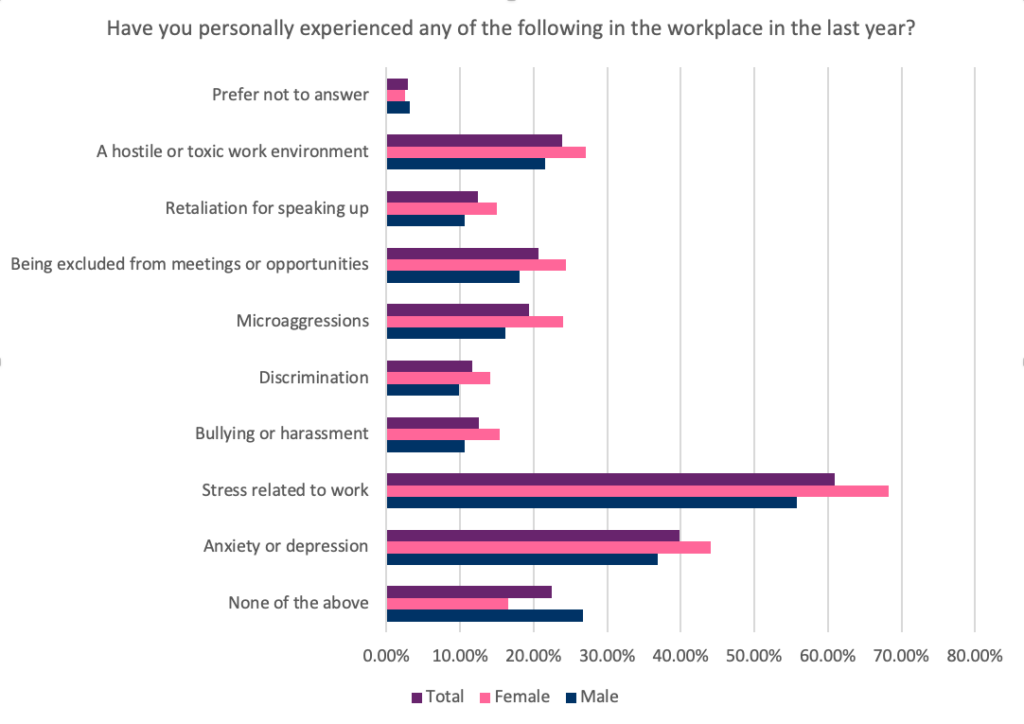
The differences are most striking when looking at workplace experiences. Female respondents report higher rates across every negative workplace experience measured in the survey and are much less likely than male respondents to say they experienced none of these issues over the past year.
Tackling these inequalities remains a priority for the union, from campaigning for fair pay and flexible working to challenging discrimination and closing the Gender Pension Gap.
LGBT+ experiences
Across the survey, LGBT+ respondents report systematically worse experiences than heterosexual respondents on workplace treatment, mental wellbeing, inclusion, and job security, alongside higher exposure to discrimination and hostile cultures.
LGBT+ respondents report lower confidence that workplaces are inclusive or welcoming, consistent with the higher prevalence of microaggressions and hostile cultures.
Prospect is committed to creating workplaces where everyone can be themselves without fear of discrimination. Through our equality work, campaigning and member-led LGBT+ network, we continue to push employers to build more inclusive cultures and tackle unfair treatment wherever it occurs.
Disabled workers’ experiences
Across the survey, disabled workers report systematically worse outcomes than nondisabled workers across job security, workload, financial wellbeing, mental wellbeing, and workplace treatment. These differences are large, cumulative and mutually reinforcing. While disabled workers are somewhat concentrated in sectors with stronger formal protections (notably the Civil Service), this does not translate into equal experiences at work.
These findings reinforce the importance of ensuring that workplaces are genuinely accessible and inclusive in practice, not just in policy. Prospect continues to campaign for better workplace adjustments, stronger disability inclusion, improved wellbeing support and fair treatment for disabled workers.
Get involved
Remember, we’ll soon be asking all recognised branches to nominate a member for upcoming equalities training and all members are welcome to join one of our networks on our Equality and Diversity Hub.
1We use the term BAME (Black, Asian and Minority Ethnic) where reporting survey results requires us to group respondents together for statistical purposes. We recognise that this term does not reflect the diversity of experiences within these communities, and where sample sizes allow, we report findings for specific ethnic groups separately.